1950s pulp sci-fi classic as Shakespeare meets spacemen meets Freud
Monday 18th October 7.15 for 7.45pm in the Linbury Room, Dulwich Picture Gallery
£8 (£6 for Friends of the Gallery) Free nibbles and wine. Google SE21 7AD for map.
In 1609 the Sea Venture set off from Plymouth as flagship of a small fleet bringing supplies and new migrants to the first successful English colony in the Americas, Jamestown. The ship was severely damaged in a violent tempest and deliberately driven onto a Bermuda reef to save it from sinking. Crew and passengers spent 9 months on that exotic island while their ship was repaired, before finally making it to Jamestown. And then the ship back to England.
This adventure was the biggest news story since the defeat of the Spanish Armada twenty years earlier. It captured the imagination of Jacobean England, including one William Shakespeare.
To his contemporaries, America was a fantasy land offering riches and a new future. Much was written by wildly imaginative writers who had never set foot there. The Americas became for the 17th Century English a socially constructed fantasy of dreamlike possibilities. But combined with danger. For Jamestown was the 12th English attempt to start a permanent colony on the land they called Virginia. A majority of the souls who took part in the previous 11 efforts died - drowned, starved, or killed by the indigenous inhabitants. Virginia meant adventure and anticipated wealth, but also danger.
Which is where Shakespeare and Forbidden Planet explore the same themes - psychological ambivalence.
Most Americans today do not have a passport. Apart from day trips to Canada or Mexico only a small minority travels abroad. So abroad can seem an alien, scary place, as often represented in Hollywood films. Large numbers of Americans left their continent and found death,in 1917-18 and in 1941-46. Forbidden Planet was released 10 years after the War in the Pacific, and just 3 years after the Korean War ended. And at the height of fears of Soviet invasion. Not to mention Martian invasion. A new generation is now finding, in Iraq and Afghanistan, that exploration and the pursuit of gold are mortally dangerous.
The ambivalence of excitement versus danger begins in both The Tempest and Forbidden Planet with this geographical exploration. Forbidden Planet starts with the characters of The Tempest, and with its opening situation. A spaceship is sent to a planet to search for colonists not heard from for 20 years.
Doctor Morbius is Prospero, enabling an update of Shakespeare's question about a second form of ambivalence: science. Can the exploration for new knowledge go too far? Prospero and Morbius use science to do good, but can they unwittingly do evil? Shakespeare wrote when the Renaissance was a hundred years old. But with the Scientific Revolution still a hundred years ahead. And the burning of women as witches in between.
Forbidden Planet was released not long after the scientific horror of Hiroshima, and the scientific industrialisation of death at Auschwitz. And with worries about global warming, nuclear power, and GM crops lying ahead in the future.
Hence our third level of ambivalence - the psychologically deepest of all. Are humans good or bad?
The Tempest's characters can be placed on a continuum from good to evil. Prospero and Morbius both have sweet, innocent, virginal daughters. Reflecting the Jacobean assumption that the natives of Virginia would be innocent, 'noble savages'. The 'natural' versus the civilised, including science. Prospero's helpful spirit Ariel has become Robby the Robot. In the middle of the continuum are the ambivalent figures of the two magician-scientists. But what about the far end of the scale- Evil?
The most interesting character in The Tempest is Caliban,a hideous, deformed monster. Not just evil but the son of evil, begotten by a witch. And confined by Prospero in a tree, repflecting the socially necessary suppression of our dark side. For Caliban expresses the dark side of nature / The New World / space. And of us, humans. Who is Caliban in Forbidden Planet? The film takes a thoroughly 20th Century route to answer this question. And contemporary ones: how can we ensure we do good rather than evil?
Hot on the heels of MADE IN DAGENHAM comes a much better film about female self-empowerment.
Ree Dolly is just 17, her father Jessop has "gone" and Momma is "sick" and "don't talk much". Which means Ree has to bring up her brother and sister (12 and 8) as well as take care of Momma. All this happens amid the tree-clad and beautiful Ozark mountains of rural Missouri.
Culturally, if not geographically, the Ozarks are an extension of the Appalachian back hills of Tennessee, Kentucky, and West Virginia. All double denim, checked shirts, unemployment and family feuds. "Cooking up crank" is both a popular local lifestyle choice and cottage industry.
This is real poverty. The horse has not been fed for 4 days. Ree has to teach the young siblings how to use a rifle. Then how to skin squirrels and prepare them for the pot. Turns out later that being able to cut up dead things comes in handy in them thar hills.
The Sheriff is looking for Ree's father who is due in court next week but cannot be found. He explains that the terms of Poppa's bail bond mean if he fails to turn up then the family will lose their house and land. "We'll have to live in the mud!!" No namby-pamby social safety net in this Cameronian-Cleggian free market paradise.
So we are perfectly set up for a Quest Film, one of the half dozen or so basic plots. For young Ree sets off wandering round the neighbours and extended family to ask if they've seen the errant dad. And a mystery emerges. Asking questions is not encouraged among the local community. "Talking just causes witnesses". "You were warned, why didntcha listen?". Something suspicious is going on. To find out what, you have to see the film.
Jennifer Lawrence is excellent as Ree. And this is so much more of a "women's film" than the faux left-leaning Made in Dagenham, for at the helm is celebrated young Director and co-Writer Debra Granik.
WINTER'S BONE won the 2010 Sundance Film Festival Grand Jury Prize, which establishes it's Indie credentials. Independent US cinema, as encouraged by Sundance, challenges the myth of many Europeans that all American films are dumb mass-audience fodder. WINTER'S BONE is an intelligent and thoughtful piece. It provides mystery and suspense without a single car chase, gunfight, or gag. And the autumnal Ozark countryside is atmospheric and beautiful.
MID will be an enormous box office success. The reasons are very simple.
1. It's about wimmin, nay working-class wimmin, empowering themselves against discrimination. So millions of women will go see it.
2. There is a new law, apparently, that all reviews of MID have to refer to it as a "feel-good movie". So that whole Richard Curtis "I wanna feel-good!!!" crowd will be queuing fast.
3. It portrays trades unions and strike action in a positive light. So everyone on the Left will go and see it, especially given the New Dawn of Edism. This, combined with 1, will draw in millions of right on men.
4. It's a British movie which has been massively hyped. This will bring in all those who (a) are desperate for the UK film industry to do well (despite making crap films) and / or (b) hate American blockbusters.
5. It's set in the 60s so will draw in herds of 60s nostalgia fetishists, irrespective of whether it accurately reflects the 60s. (See "The Boat That Rocked")
6. Everyone covered under 1 to 5 will fall for the hype and tell all their friends it is "the best movie ever made", "it's really really feel-good!!!" etc. Bringing in even more millions.
7. It's got Sally Hawkins in it, who gurned her way, appallingly, through previous bad British film HAPPY-GO-LUCKY (bit like "feel-good" - are you getting the picture?). And there's another new law that she has to be promoted as (a) a wonderful new talent and (b) the future of the now-being-reborn UK film industry.
In other words it's a triumph of marketing that will be studied in business schools for many years to come. It illustrates the difference between advertising and marketing. The latter meaning you plan for what demographics (see 1 to 6 above) you are going to sell to BEFORE you even design the product. Which means YOU are being manipulated even as you consider - for no longer then 3 seconds probably - whether to go and see it.
Since I'm already clearly biased, here's a few snippets from a couple of the less hysterical user reviews on imdb.com. And note that these are quotes from what are positive reviews overall.
"The film has all the look and feel of a TV movie and is utterly predictable in its mix of humour and tragedy."
"The movie is set in May/June 1968 and it's a pity more care wasn't taken to ensure the period detail was spot on."
"All the ingredients of a British feelgood movie are there but the overall effect is somewhat spoilt by the tendency to portray all the male authority figures as buffoons."
"It's just a pity that in portraying the women as strong salt-of-the-earth characters, the men have to be seen as caricatures."
"This is big screen TV material. A bit of humour; a bit of heart-string tugging; a bit of stereotyping; a bit of costume drama, a bit of vintage vehicle spotting; a bit of real life documentary; a bit of 'celebrity star' spotting - actors playing roles you wouldn't think they'd take; a bit of flesh baring, a bit of social comment; a bit of this and everything else so as no one feels left out. Trouble is, this makes it a Jack & Jill of all trades and master/mistress of none".
"It is, at the end of the day, a superficial treatment of a ground breaking industrial dispute."
Or how about rottentomatoes.com?
"It’s jolly stuff, yet for all the bawdy banter, there’s a Boat That Rocked-like sense of a genuinely interesting moment being regurgitated as a cuddly sitcom."
"I'm not saying Made In Dagenham is a shallow piece of nostalgic fluff. But within five minutes, Bob Hoskins is singing My Old Man Said Follow The Van during a power cut."
The comments about the male characters are perhaps the most subtly significant. Basically, it's a chick flick. As a few minutes spent watching TV advertising will reveal, marketers sell to men using sex, and to women by portraying men as stupid.
That is perhaps the ultimate irony. A film promoted as about women's self-empowerment will make millions by manipulating women. The film clearly (some would say, rather obviously) reveals women's oppression by capitalism as workers. Less obviously it reflects how women are oppressed by capitalists as consumers. I wonder what Naomi 'No Logo' Klein would have to say?
Shakespeare meets Sci-Fi in this 1950's pulp classic.
In 1609 the Sea Venture set off from Plymouth as flagship of a small fleet delivering supplies and bringing new migrants to the first successful English colony in the Americas, Jamestown in Virginia. Separated in a violent storm, the Sea Venture was severely damaged and deliberately driven onto a Bermuda reef to save it from sinking. Crew and passengers spent 9 months on the exotic island while their ship was repaired, before finally making it to Jamestown.
The story of this adventure captured the imagination of Jacobean England. Including one William Shakespeare, the tale influencing The Tempest. To the contemporary English, America was a fantasy land offering riches and a new future for settlers and the nation alike. Much was written about the continent by wildly imaginative writers who had never set foot there. Thus the Americas became for the 17th Century English a social fantasy of dreamlike possibilities combined with alien dangers.
A bit like space exploration for the generations of 1950s America. Forbidden Planets starts with the characters of The Tempest, and with its' opening situation. A group are (space)shipwrecked and meet some people who've been there longer. Doctor Morbius is Prospero, enabling an update of Shakespeare's exploration of the dangers of science - can it go too far!? His innocent daughter Altaira enables the 17th century consideration of nature versus civilisation, so inspired by the American discoveries. She has never been kissed, and now there are hunky spacemen around! Helpful spirit Ariel has become Robby the Robot. And who now is the deformed monster and witch's son, Caliban? Representing the dark side of nature / The New World / space? Well, you have to watch the film to find that out.
Serious fans of Shakespeare should not come to this movie expecting a deep, intellectually stimulating version of his play. Forbidden Planet is, ultimately, pulp science fiction. But what it captures in updated, 20th Century form is the atmosphere of exploration, and the ambivalent feelings about discovering the new and unknown. From 1609 Bermuda via Prospero's island to space in the 23rd Century Shakespeare's original themes are explored in an undoubtedly interesting manner.
That is largely because of an intellectual influence on the script even more important than Shakespeare, that of psychoanalysis. Freud's theories about the unconscious were popular in Hollywood scriptwriting circles in the 1940s and 1950s. It was common for films of the period to explore the significance in life and society of darker, unconscious motivations, So the real updating in Forbidden Planet goes beyond space and future and explores what it means to be human given Freud's discovery of the unconscious. What it means to us, now, the contemporary audience.
So, in short, Forbidden Planet is NOT a serious version of Shakespeare. But it is a lot of fun and does explore some of the Tempest's themes in a contemporary context.
More event details at http://www.dulwichpicturegallery.org.uk/whats_on/galleryfilm/forbidden_planet.aspx
I went to see THE DISAPPEARANCE OF ALICE CREED as it was the only show in town. Normally I avoid contemporary British films. Too derivative, too much film studies, too many zombies or gangstas, posh people in mews cottages. And don't even start me on serial Cinema Criminals Guy 'Geezer' Ritchie and Richard 'which US actress is available to play opposite Colin Fith and / or Hugh Grant' Curtis.
And a short while into ALICE CREED I began wondering what the hell will women think and feel who watch this? And do we really need yet another WIP movie - Woman In Peril? For the opening sequence is stunning in it's creation of a sense of menace. Two grim, unsmiling men appear to be collecting materials for some DIY. Then it becomes clear they are preparing a dungeon. Fully sealed off from the outside world and with plenty of chains and locks.
Soon enough it gets worse. Alice Creed is kidnapped and chained up. Scissors appear and her clothes are systematically cut off. The tension is almost unbearable as her naked body suggests a new sexual element of menace.
But this is not a routine WIP movie, nor a routine movie of any sort. A series of plot twists appears which are genuinely suprising. All sorts of the audience's assumptions about the characters' identities and motivations prove incorrect. Let's just say that Alice is not a passive victim. This is a truly intelligent suspense movie which will entertain those capable of managing the claustrophobic tension and menace. For most of the action takes place in just two rooms.
A most interesting aspect of the film is its' cast list of just three - Alice and the kidnappers. My first experience of Gemma Arterton left me disappointed. Did not meet the expectation left with me by the Guardian headline "The vertiginous rise of Gemma Arterton". She does a good job when Alice has to look scared, nay terrified. But once she opens her mouth it's like yet more mockney / posh girl's school standard modern Britfilm chickspeak. (See my previous piece about Rachel Weisz.) As a millionaire's daughter one expects some aristo vowels, but we get sentences like "I thought I was going to (posh accent so far) DOIY!!!"
The strongest performance is that of experienced British character actor, Eddie Marsan, as the long-time pro criminal, Vic. All tension and threat and tattoos. But revealing other sides to a 3 dimensional character. And providing an unexpected contribution to the ending. Give him an award.
The other star of the film is the editing, contributing majorly to the film's tension and menace. By jump-cutting within takes we seem to accelerate horribly towards that which we fear is going to happen. In similar fashion the inventive sound editing jumps brutally at times from silence to sudden noise.
THE DISAPPEARANCE OF ALICE CREED is not suitable for those of you seeking a relaxing 90 minutes. Or those recently released from kidnap. It is a very well-writted and dramatic thriller which will keep you engaged and looking for the next plot twist.
Film of the week won the Oscar for Best Foreign Language Film - Argentine crime procedural THE SECRET IN THEIR EYES. It's Inspector Morse meets Love in the Time of Cholera. It's 1999 and Esposito, a Federal justice agent, is writing up as a novel a rape-murder case he investigated back in 1974. So lots of flashbacks and forwards.
There's alcoholic comedy and shades of Bad Boys from sidekick Sandoval. And a romantic sub plot that runs alongside the mystery and then suddenly it's, um, not a subplot any more. Finally, as it's the 70s we are not far away from military rule. So there's a political subplot guaranteeing lots of genuinely surprising twists and turns.
Argentine cinema is where it's happening at the moment, and this is a great example. Reminscent of the best of Golden Era Hollywood, an intelligent mystery story interweaved with comedy, romance and social comment. And all beautifully filmed. Do not miss it.
Runner up features a terrifying and repulsive species that hunts in large numbers and destroys all in its' path. That's right, American teenagers. Luckily thousands of them get dismembered, killed, or just chewed up a bit in PIRANHA 3D.
It's Spring Break on Lake Somethingorother, USA, and vast swathes of semi-naked youth are partaying all night and day. Cute MILF sheriff Elizabeth Shue from Leaving Las Vegas just can't keep them under control. So when the revived pre-historic killer fish come round hungrily looking for lunch it's kind of a shame they just laugh when she screams "Get outta the water!!!"
Not a shame for the audience though. As PIRANHA 3D is a fine example of its' genre - gore fest meets teens in peril. They don't often make exploitation movies as good as this any more. So if you like lots of death, blood and mangled bodies don't miss it. The body mangling special effects are great. While many of the obnoxious teens are, of course killed, quite a few are only half eaten. Can't wait to see the Making Of to find out how they did the scenes with kids with only head and torso left and still talking. Cool!
Rarely has so much screen time been filled with attractive young women gyrating in bikinis. Far more than the plot strictly demands. Ditto when England's sweetheart and underwear model Kelly Brook gets her kit off with a fellow porn actress for some tasteful crypto-lesbian underwater swimming shots. The camera does not so much linger as loiter with intent. But don't worry, it's all feminist really as there is an excellent, um, climax involving a porn director's penis.
PIRANHA 3D is really, really, really funny. I was wincing the whole way through.
Bronze goes to THE GIRL WHO PLAYED WITH FIRE, second in the Stieg Larsson trilogy. Bottom line is it's not a patch on the first one ( . . . With the Dragon Tattoo), but still a decent mystery thriller. If you've read the book you'll inevitably say it's a disappointment. And if you've not seen the first one, you really have to go and see the first one, first. It's even darker than it's excellent predecessor, with greater focus on Lisbeth Salander's tortured psychology and more details of the grim childhood which was the cause.
Noomi Rapace's extraordinary performance as the eponymous heroine is worth the admission price alone. An astonishing display of brooding paranoia and hate. An injured, scared and angry animal coiled to strike. Imagine the kick-ass action capability of Angelina Jolie combined with the sheer emotional suffering of an on-form and ultra-miserable Juliette Binoche. All the more amazing given that Rapace hardly has any words to say. A masterclass (mistressclass?) in movie acting - all dark eyes and terse facial expressions in close up. Being and feeling, rather than acting.
When she's not around it's a bit clunky to tell the truth. Lisbeth and Blomqvist are hardly on screen together, so their combined chemistry of the first film is just not there. And the film has an annoying habit common to movie adaptations of crime novels. We keep being given information - tons of it - via various pairs of people meeting up and one telling the other loads of stuff. So at times the movie seems to comprise scenes like that interspersed with people traveling to meet someone for another scene like that. "Show it, don't tell it" is one of the basic rules of good scriptwriting, and this film at times shows why.
But THE GIRL WHO PLAYED WITH FIRE is still a good thriller and one of the best films on release at the moment.
Three films which argue the case for immediate legislation to ban movies over 2 hours long. Come on Coalition.
Not much for the art movie crowd on general release at the mo, so many will be tempted by the over-long and plodding GAINSBOURG. No one split the French public like Serge G, and this biopic fails fully to demonstrate why.
On the one hand a talented polymath - artist, pianist, guitarist and songwriter, then singer - and above all a musical innovator. On the other hand a troubled and repulsive man, his life dominated not just by alcoholic excess but by an increasingly embarrassing obsession with sex. Manifested in a bizarrely successful interest in younger and younger women and in tacky, tastelessly prurient song lyrics. French women divide into those who loathe him for his sexual expressions and those who wanted to sleep with him.
Eric Elmosnino is superb as the adult Lucien, name changed because he was told it "sounds like hairdresser's boy". He takes Lucien / Serge from shy young man hamstrung by lack of confidence in his looks to hideously slimy, alcoholic lounge lizard. But even this massive performance cannot save what is just a boring and unsatisfying film.
It fails as drama, falling into the biopic trap of trying to show too much of the subject's life. It fails as explanation, despite some cod Freud and a half-assed Terry Gilliamesque device - a character wearing a large papier mache head with an enormous nose. meant to reflect Gainsbourg's preoccupation with Jewishness, looks and being an outsider.
It also fails in honesty. In racking up a record number of cliches - artist as precocious, different, outsider, troubled, special, rebel etc. yawn - it falls into the trap of liking the subject too much and downplaying his downside. Innocent 16 year-old singer France Gall was persuaded to record a song he wrote for her about a girl who likes lollipops. She and her agent father failed to realise that the song was but a string of references to oral sex. Apart from being crassly vulgar, this almost destroyed her career, and blighted it for years. In the film the episode is treated as a boyish prank by a charming 60s rebel.
It is that 'rebel' persona which is most offensive in the film and accounts for much of the adoration of Gainsbourg by millions of his compatriots. French culture could not handle the youth and music revolution of the 60s, tied up as it was with Anglo-American blues-based pop and rock. How could young French people express themselves in a music culture dominated by slow, miserable ballads and jaunty, Django Rheinhardt jazz?
Johnny Halliday, Sylvie Vartan and France Gall tried to imitate cross-Atlantic pop and rock with French lyrics and French accents. Others stayed stuck in national musical traditions left somewhere between the wars.
Gainsbourg began in traditional style - ballads or Django guitar. In the mid 60s he joined the "ye ye" pop movement of Vartan and Gall. But soon became France's foremost popular music innovator. Experimenting, synthesising, taking genres from all over the world and mixing them up. Constantly trying new things.
Was it any good? Not to anyone outside of France, lol! But for hip young French people Gainsbourg offered a vehicle to differentiate themselves from their parents while also asserting a national identity separate from the Anglo-Americo-Saxons. And as Gainsbourg slept with Bardot and Birkin, drank too much, and ignored sexual mores he became a rebel icon.
But French society has remained far more conservative than those of the US or the UK. So it does not take much to be a rebel on that side of the Channel. On this side the 'scandal' of Gainsbourg's reggae version of La Marseillaise - "Aux Armes, Etcetera" - just seems naff. In the movie he screams at protestors, "I am a rebel, and this is a rebel song!"
In fact it was a revolutionary song. Revolutionaries change things. Singers who smoke too much and drink themselves to death change nothing. Rebel Without A Point.
INCEPTION is promoted as intelligent sci-fi meets gripping action but it is just vacuously over complicated, over long, and boring. The script, which apparently took 10 years to develop, commits the ultimate Crime Against Cinema by failing to develop its' characters in the first half. And in some cases, not at all. For over an hour I just did not care about the characters enough to try and understand what was going on. By then it was too late.
It must be a first in DiCaprio's career to play a character so unable to generate empathy or interest. He is flat, one-dimensonal. A sub-plot about his wife - is she alive, dead, a figment of imagination? - only begins to take off after an hour or so. By which point I did not care. A criminal misuse of the best thespian in the piece, the sublime Marion Cotillard. Apparently willing to be in any old crap to make it in Hollywood. All other characters are entirely lacking in any personality whatsoever. Cardboard cut outs.
The story completely failed to make me suspend my disbelief, so I will not test the reader with it in detail. One capitalist wants to manipulate another capitalist (are you caring?) and employs Leo's team to enter into the target's dreams and implant an idea (do you believe?) which will destroy his commercial empire and leave the client dominant in the market place. The rest is crap science and sub-Bourne action.
Stick with The Matrix and Total Recall.
Finally KARATE KID is, you guessed, over-long and boring. Beautifully shot, it succeeds well in its' primary purpose as an advert for China as tourism destination. And does quite well in its' subliminal role to portray China as modern, commercial, high-tech country full of brand new cars and no hint of human rights violations.
As for the rest, it's that Dr Johnson review all over again. It is "both good and original; unfortunately the good parts are not original and the original parts are not good".
The original Karate Kid is one of the best coming-of-age movies ever made. The relationship between fatherless, bullied boy and damaged old Japanese drunk, Mr Miyagi, displays great psychological depth, taking the film to an almost spiritual level.
In this sequel the story is entirely unchanged. But in another Crime Against Cinema they have omitted the totemic "wax on, wax off" sequence and line, which provided the entire basis of both the Myagi method and the metaphor of how younger males can, should and sometimes do learn from older men. Robert Bly's "Iron John" made flesh (OK, celluloid) and a text book for the gender-role re-negotiations of our times.
This time round the kid's journey to Kung Fu champion (it's not Karate any more) in just one week is entirely unbelievable. Especially so as newcomer and instant star Jaden Smith is incredibly good at it. Jackie Chan's damaged, alcoholic mentor has him take his jacket off and put it back on for a few days and suddenly young Jaden can do all the moves and at miraculous speed. Just silly.
Chan bravely attempts a deeper, darker persona than in his career so far, and does not entirely succeed. But A for effort and keep it up. Meanwhile Jaden Smith is superb is all aspects - action, comedy, being cute - but then with two Hollywood A-list parents his stardom will hardly be a surprise.
A last word for the character of Jaden's screen mother. A cringe-makingly embarrassing stereotype of The African-American Mother. Not since Gone With the Wind have we seen such lawdy eye rolling. The nearest this re-make gets to the psychological depth of the original is a subtle, even subliminal put-down of that stereotype. In the absence of Jaden's deceased father she cannot get her boy to hang up his jacket; male mentor Chan can. But she will be box office gold, as no one laughed louder in the Camden Odeon at her antics than the Black British women in the audience.
Throughout this article are references to images. Each one can be found by clicking on the appropriate link to the top and right of this page. You will need to click your browser's BACK button each time to return to this article.
DAYS OF HEAVEN (1978, PG, 95 mins) is one of the most beautiful and unusual American films of the 1970s (Image AA). And there is a rare chance to see it on the biggish screen at Dulwich Picture Gallery on Monday 19th July at 19.45 - booking information at GalleryFilm http://www.dulwichpicturegallery.org.uk/whats_on/friends_events_booking_details.aspx).
It is screened alongside the Gallery's summer exhibition, The Wyeth Family: Three Generations of American Art (http://www.dulwichpicturegallery.org.uk/exhibitions/coming_soon/the_wyeth_family.aspx)
A choice reflecting the common idea that Days of Heaven is "strongly inspired by Andrew Wyeth’s paintings". That's true but the influence should not be exaggerated. It is more accurate, and more enlightening, to see Andrew Wyeth and Days of Heaven's Director, Terrence Malick as swimming within the same, broad US cultural movements and reflecting a common heritage. The specific influence of Wyeth on Days of Heaven is undeniable, best seen in the many shots of the ranch house on a hill reflecting Wyeth's best known painting, Christina's World (1948) (Images A and B).
But it is more interesting to see from a wider perspective how Wyeth and Malick share an important socio-cultural position. Both men straddle the artificial division between 'High Art' and 'popular / commercial' culture. Wyeth merits display in such an august institution as the Dulwich Picture Gallery. Yet his work has been dismissed by some as "sentimental", "mere illustration", "emotional", "formulaic stuff". Wyeth was known as the "Painter of the People," because of his work's popularity with the public.
This divided reaction mirrors the fallacious division of cinema into two rigidly separate realms, the worthy one of the "arthouse" and the despised one of the "popcorn multiplex". Malick's films are fascinating in how they challenge the snobbish assumption that all American cinema belongs in the latter category. Like all his films, Days of Heaven is a Hollywood film, featuring Hollywood stars, and made via the Hollywood system, albeit an off-centre strand. Producer Bert Schneider was also a cross-over figure. Co-creator of plastic TV pop group The Monkees. But then an avid supporter of the New Hollywood via Easy Rider, Five Easy Pieces and, later, Days of Heaven.
At times Days of Heaven looks and feels like a Western, structured narratively as it is around two common themes of that genre, the parallel battles of man (sic) versus nature, and civilisation versus man's (sic) lower, passionate nature. A battle for "order" on both levels.
The "art" v "popcorn" fallacy rests heavily on another myth, that of the "auteur" as solo filmmaker, responsible alone for a film's entire artistic and literary content.
Malick is often claimed as a rare example of a Hollywood auteur. Not surprisingly given the signature trademarks which run through his films. All of which are present in Days of Heaven: strong visual narrative; shot almost entirely outdoors; use of minimal electric lighting; characters often backlit and filmed towards late afternoon / early evening; much on the spot improvisation; use of almost disembodied voiceover to drive narrative. The result is a series of films often described as 'hypnotic' or 'transcendental'. A long way from standard Hollywood fare.
Malick's auteur persona reflects how unusual he is as a Hollywood filmmaker. He studied philosophy at Harvard and Oxford, then taught at M.I.T. Since his first feature, Badlands in 1973, he has made a total of just 5 features in 37 years. Compared to the 31 films directed by that undisputed Hollywood auteur, Clint Eastwood in a similar period. In between films Malick has continued to teach. Clearly a man not driven by standard Hollywood motivations of fame, wealth or ego.
On the other hand, Malick is in some ways a quintessential American. Born in the spirit of E Pluribus Unum into a family of middle-eastern (Assyrian) background. Brought up as a farm boy in Oklahoma and Texas, neither known as hotbeds of High Art. Established in his Ivy League career the lure of Hollywood drew him from the East Coast via the not unusual route of journalism then scriptwriting.
Like Wyeth, Malick has been criticised from two directions. To hardline arthouse fundamentalists his films are "superficial" and "sentimental", not distinct enough from mainstream Hollywood. While users' comments on IMDB by members of the multiplex demographic who have stumbled on his work via DVD rentals frequently include the words "boring" and "pretentious".
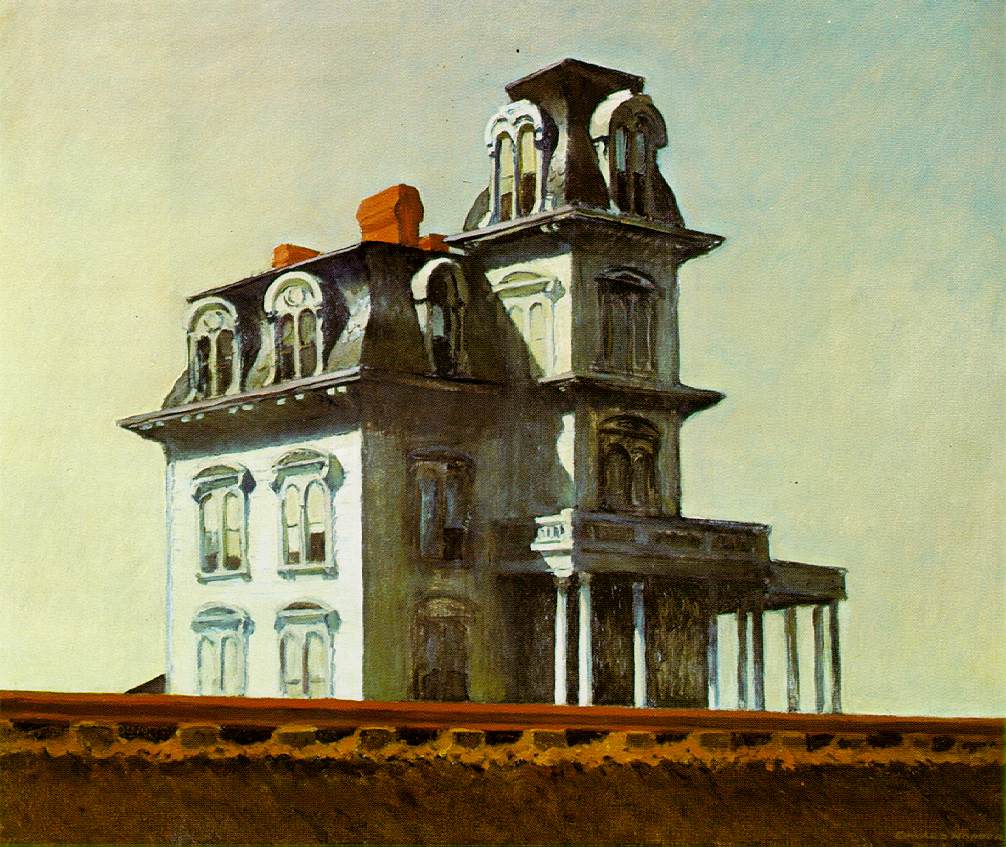
Commonalities in Wyeth and Malick are seen via other influences on Days of Heaven. Beyond Christina's World, the famous house in the film is almost an exact copy of Edward Hopper's The House by the Railroad (1925) (Images C and D). And also reflects Hopper's American Landscape (1920) (Image E).
The word "landscape" provides an important clue for our discussion. Much of Wyeth's work features people in a landscape. His landscapes often appear empty, even bleak. Malick's first four films (the fifth is currently in post-production) all feature individuals in conflict in and with their landscape.
In the significantly titled Badlands (1973) two young lovers go on a killing spree, pursued by law officers. Eventually they build for themselves an artificial environment of tree houses and underground hides. Days of Heaven (1978) features, as we have seen, human v human and human v nature conflicts on the wide open plains of Texas. In the Thin Red Line (1998), US soldiers in World War 2 must scale a steep mountain against the withering fire of entrenched Japanese soldiers, protected only by deep but fatally thin grass. In the New World (2005) English colonists in 1607 battle with the alien environment and alien peoples of what is now Virginia. native princess Pocahontas marries one of them and must in turn face the equally alien urban landscape of Jacobean England - the New World of the title. The content of Tree of Life, currently being edited and scheduled for release in November 2010, has been kept vigorously secret. But we know it is set in the Midwest of the 1950s, and rumours claim it is "an inter-generational rights of passage drama in the style of John Steinbeck".
Morrison and Schur sum up parallels in Wyeth and Malick thus, "these works share a concern over the effects of modernity on the relationship bet humans and their environment . . . the ways in which industrial culture . . . may be seen to displace humans from their sense of connection with nature". (The films of Terrence Malick, by James Morrison, Thomas Schur)
These mutual 20th Century concerns have a long history which goes to the heart of American culture. And indeed to that overlap between "popular" and "High" culture.
Well into the 19th Century both American intellectuals and nationalists bemoaned the lack of a genuinely domestic culture. It was argued that across all art forms the US was still effectively an offshoot of Europe in general and England in particular.
A genuinely vernacular American culture is often said to have begun in literature, it's hallmarks important to this discussion. Fenimore Cooper's Leatherstocking novels (Last of the Mohicans et al), begun in 1823, and Melville's Moby Dick of 1851 are regarded as important landmarks. These have in common men (sic) battling against nature or each other outdoors in land- and seascapes. They also share a sort of simplicity.
That word is used here not to mean intellectually vacant or simplistic. But that this trend reflects the cultural tradition of the US North East for religious, spiritual and cultural simplicity, as the word is used by Quakers. An overt and self-conscious attempt to get away from the Old World of Europe with its fustiness, tradition, and class hierarchies. It's rococo and baroque. The woodland battles of Leatherstocking can be seen in this light as the antithesis of the drawing rooms and psychological interiority of the likes of Jane Austen.
Around the same time another literary and philosophical tradition emerges, Transcendentalism, characterised in literature by Henry David Thoreau's Walden (1854) and the poetry and essays of Ralph Waldo Emerson. Both reflected similar themes of simplicity and nature. Andrew Wyeth's father N.C. Wyeth was very influenced by the Transcendentalists.
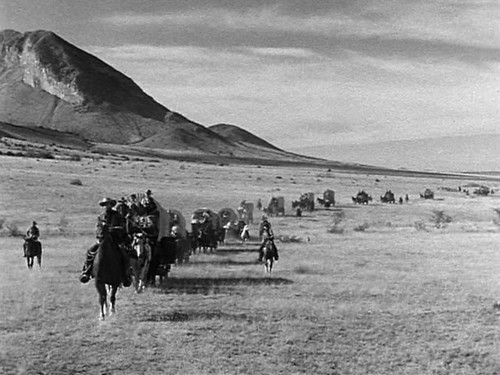
In the 1840s, American expansion westwards took off with the later to be traditional Hollywood wagon trains of settlers heading across the Plains. Simple people battling with and in new landscapes. With them went artists who visually idealised both the landscape and the noble settlers, often backlit, Malick-style, by the setting sun. Famous examples are Leutze's 1851 Westward the Course of Empire Takes it's Way (Image F) and Bierstadt's 1867 Emigrants Crossing the Plains (Image G). Judged by the values of High Art these classics of 19th century Western art now appear cliched, populist, even embarrassingly politically incorrect.
In their footsteps followed the more artistically worthy Frederic Remington (1861 to 1909) (Image H) and Charles M Russell (1864 to 1926) (Image J). The work of both can be seen to be less sentimental, less "corny" than Leutze's and Bierstadt's. Yet both feature heavily the themes of cowboys, horses, Indians, soldiers - men (sic) battling in and with landscapes. Their paintings could easily serve as storyboarding for Western movies. And both men's lives overlapped with the beginning of that genre, 1903's silent The Great Train Robbery.
The Western artists were followed, though not literally, by the popular literary fraternity. Western adventures became a common theme in the explosion of ‘dime novels’, the U.S. equivalent of the British ‘penny dreadful’. Churned out factory-style by hacks who had never been West of the Appalachians these represented the undeniably ‘low’ end of American literarture.
But a whole new standard of literature was reached with the publication of Owen Wister’s The Virginian in 1902. Not only does The Virginian work as serious drama, it explores intelligently the very real social conflicts of the 19th century West. The background to the Virginian lay in the 1892 Johnson County War, a violent confrontation between rich, "big" cattle barons and poor, "small" farmers, mostly recent migrants from Europe and Russia. Which in turn directly spawned the 1980 Heaven's Gate and the 2002 Johnson County War. But the ranchers vs. farmers battle became one of the most common tropes in Western films, feeding into the likes of Shane (1953) and The Big Country (1958).
We are now into the 20th Century and can connect our chain of links to the Wyeth family. Andrew's father, N.C. Wyeth was commissioned in 1904 by the Saturday Evening Post to illustrate a Western story. His teacher and mentor, Howard Pyle " . . . urged Wyeth to go West to acquire direct knowledge, much as Zane Grey had done for his Western novels. In Colorado, he worked as a cowboy alongside the professional "punchers," moving cattle and doing ranch chores. He visited the Navajo in Arizona and gained an understanding of Native American culture. When his money was stolen, he worked as a mail carrier on horseback to gain back needed funds". This was the first of several trips West by Wyeth senior.
Thus we have traced a tradition of vernacular American culture in which painting, literature, landscape and Westward expansion go hand in hand. A tradition in which 'High Art' and popular culture, including illustration, sit together on an undivided continuum. Characterised by simplicity and populism, and by themes which both reflect and entertained "the people". Heavily featuring the outdoors in general and the trans-Missisippi West in particular. All of which provided fertile material for Hollywood movies in general and The Western in particular.
This was the cultural stream into which both Andrew Wyeth (1917) and Terrence Malick (1943) were born, and by which both were heavily influenced. Wyeth was there first, but both drank from the same waters.
And the tradition has continued during their lifetimes. The literary inheritors of the Melville / Fenimore Cooper tradition include Ernest Hemingway (1899 to 1961) and Norman Mailer (1923 to 2001). In painting we may note Harvey Dunn of South Dakota (1884 to 1952), notably his 1950 The Prairie is My Garden (Image K). And California's Maynard Dixon (1875 to 1946), with works like 1942's Open Range (Image L).
After Wister's The Virginian, Western literature continued to evolve in the 20th Century. The novels of the hugely popular Zane Grey are credited with having spawned no less than 110 films. But also inspired a 'wealth' of lesser writers, lampooned via Joseph Cotton's Holly Martins character in the British film noir The Third Man (1949).
The contemporary writer, Cormac McCarthy on the other hand has achieved genuine literary recognition via various awards including the Pulitzer Prize for works in several genres as well as the Western. And for providing starting points for movies such as No Country for Old Men (2007). Another contemporary writer is the prolific Larry McMurtry, whose writing ranges from the more or less conventional cattle drive plot of Lonesome Dove (1989 and 1993) to the screenplay for the artistically acclaimed gay cowboy movie, Brokeback Mountain (2005).
Every artist or author named so far, and all who will be named further on, is a man. Their themes are relentlessly masculine. Their works have often been denounced as patriarchal, sexist. Their content privileges male physical struggle, and tends to reduce women to, at best, secondary and support roles, and at worst, complete absence. More of this later.
It is often said that the art form of the 20th Century has been film. And that film has been THE American art form, the USA's unique and technology-based contribution to the evolution of the creative arts. Since the arrival of sound, cinema has brought togather the literary / theatrical and the visual. And the simple, outdoors tradition of the Western has been at the heart of that fusion.
Two of the greatest names in American cinema, and among the strongest visually, are John Ford (1894 to 1973) and Howard Hawks (1896 to 1977). Both Ford and Hawks were worshipped by the directors of the French New Wave as auteurs and as powerful influences on their own work. Influence often ignored by those who assert that rigid separation between the 'art film' of the elite and and the 'popcorn movie' of the vulgar masses.
Hawks' 1948 Red River and Ford's 1956 The Searchers are celebrated as two of the best American films ever made (Images M and N). Both feature the man who can arguably be designated the absolute antithesis of the arthouse film - Iowa-born son of the Midwest Marion Morrison, stage name: John Wayne. It seems incongruous to use his name in the same sentence as the word 'art' so much does Wayne appear the embodiment of all that is regarded as commercial and vulgar in US popular culture.
Yet Wayne's minimalist acting style, and his mumbling, plain-speaking characters, usually set by Hawks or Ford backlit against a wide-open sky in a vast landscape, represent the themes that link Andrew Wyeth and Terrence Malick - the simple, the strongly visual, the outdoors, people in landscapes much bigger than they are. Ford's famous habit of tearing out many pages of dialogue preferring to "show it rather than say it" worked perfectly for Wayne. And vice versa. Malick often uses his male actors similarly. In Days of Heaven a female voiceover narrates while we watch the less articulate men in action. Wayne continues our theme of the aggressively, conventionally masculine.
Malick's films are overwhelmingly populated by male characters, who will generally be fighting each other. Casting delivers to us established Hollywood stars who combine hearthrob good looks with traditional masculinity: Martin Sheen (Badlands), Richard Gere and Sam Shepard (Days of Heaven), Sean Penn and George Clooney (The Thin Red Line), Colin Farrell and Christian Bale (The New World), Brad Pitt (The Tree of Life). Female characters are there to be loved, fought over, dragged along, or to narrate. The best known actress in a Malick movie was Badlands' Cissy Spacek from way back in 1973. Since then no Malick film has featured a very well-known actress.
We can finish by pulling together the cultural streams from which both Andrew Wyeth and Terrence Malick appear to have emerged. All can be seen to be part of the evolution of a vernacular American culture characterised by simplicity, the visual, and the landscape. What can be shown literally is privileged over the abstract, ideas, intellectualisation. Malick, despite his artistic auteur persona, fits within the mainstream US traditions of literature, Western art, and film. He also prioritises visualised action over words, and features Western landscapes, masculine themes and images, and conflict between men.
All of which challenges those who come to Wyeth's and Malick's works from the perspective of traditional 'High Culture'. From Manhattan and Boston to London and Paris intellectual elites have their preferences. and prejudices. Film should privilege ideas and words over action. Novels should feature strong characters and complex plots, not physical action. 'Art', cannot by definition be too popular. Andrew Wyeth's huge attendance figures automatically make him suspect in a world in which being part of an elite minority is a qualifying requirement for artistic status; art can only be Art if its' creators, creations and consumers are in some way 'special'.
Above all, 'the artist' should be a million miles away from the cigar-smoking, bullfighting machismo of John Wayne or Ernest Hemingway. Which brings us to another and final psycho-cultural split, the socially constructed separation between male and female, men and women.
In its traditional social role 'art' has stood between and linked the two worlds. Male artists and writers are expected to be sensitive, able to explore the inner world, to understand their female characters. Male homosexuality is far more accepted in the world of high art than in the military or Western settings of Ford, Hemingway or Mailer wherein men are without exception always 'real'.
Andrew Wyeth and Terrence Malick can both also be understood to link the cultural worlds of the masculine and the feminine. In Wyeth's work we see the traditional American outdoors, yet an absence of aggressive, violent masculinity. When his subjects are women, he appears to understand them empathically.
Malick's films overwhelmingly involve men in violent conflict, and yet the the films' overall visual and narrative style is a long way from the standard Hollywood action film. The word "lyrical" is overwhelmingly used to describe his films, which seems to refer to that transcendental, out-of-body quality which results from the combination of music and voiceover with hypnotic cinematography. While we see men behaving badly in his films, they are enveloped by an artistic process that is somehow female, conveyed to us via sound and image. The sound often involving that female narration. Men do. Women notice, feel, examine, talk.
Furthermore his male characters can be divided into two types. On the one hand are those who we see very clearly to be experiencing terror. The young soldiers in The Thin Red Line, Colin Farrell's John Smith in The New World. These characters are complemented by men driven by the calm, gentle version of love, known by the Greeks as 'agape', rather than the murderous, lustful form. Sam Shepard's gentle farmer in Days of Heaven, or Christian Bale's gentle farmer who rescues Pocahontas via marriage in The New World.
On the other hand are the most violent of Malick's men. Those who are driven to violence by passionate emotion or desire: Richard Gere in Days of Heaven. Or by an almost emotionless, even psychopathically calm aggression: Martin Sheen's killer in Badlands, or Nick Nolte's screaming officer in The Thin Red Line, cajoling and threatening his scared young soldiers towards their deaths.
To conclude, when we compare the paintings of Andrew Wyeth and the films of Terrence Malick we are challenged to reconsider elitist assumptions as to a rigid separation between ‘high’ and ‘popular’ art, and in parallel, the between ‘art films’ and the commercial cinema.
This is an excerpt from an interview included with John Bailey, the camera operator on the film. The DP was Nestor Almendros and then Haskell Wexler took over to complete production. One of the most stunning looking films in the history of cinema. Large portions of the film were shot outdoors with little or no artificial light in what is called the "magic hour", the period in which sunlight gives way to night. Almendros used 50mm lens with the aperture opened to the maximum (f-1.4 and f-1).