Saturday, July 3, 2010

. . . go and see DAYS OF HEAVEN at Dulwich Picture Gallery, 19th July 2010

Throughout this article are references to images. Each one can be found by clicking on the appropriate link to the top and right of this page.  You will need to click your browser's BACK button each time to return to this article.


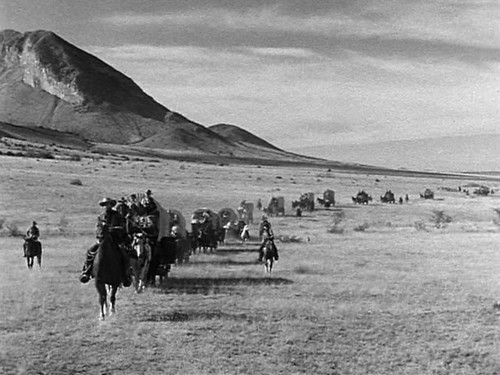
DAYS OF HEAVEN (1978, PG, 95 mins) is one of the most beautiful and unusual American films of the 1970s (Image AA).  And there is a rare chance to see it on the biggish screen at Dulwich Picture Gallery on Monday 19th July at 19.45 - booking information at GalleryFilm http://www.dulwichpicturegallery.org.uk/whats_on/friends_events_booking_details.aspx).  

It is screened alongside the Gallery's summer exhibition, The Wyeth Family: Three Generations of American Art (http://www.dulwichpicturegallery.org.uk/exhibitions/coming_soon/the_wyeth_family.aspx) 

A choice reflecting the common idea that Days of Heaven is "strongly inspired by Andrew Wyeth’s paintings". That's true but the influence should not be exaggerated. It is more accurate, and more enlightening, to see Andrew Wyeth and Days of Heaven's Director, Terrence Malick as swimming within the same, broad US cultural movements and reflecting a common heritage. The specific influence of Wyeth on Days of Heaven is undeniable, best seen in the many shots of the ranch house on a hill reflecting  Wyeth's best known painting, Christina's World (1948) (Images A and B).

But it is more interesting to see from a wider perspective how Wyeth and Malick share an important socio-cultural position. Both men straddle the artificial division between 'High Art' and 'popular / commercial' culture.  Wyeth merits display in such an august institution as the Dulwich Picture Gallery.  Yet his work has been dismissed by some as "sentimental", "mere illustration", "emotional", "formulaic stuff".  Wyeth was known as the "Painter of the People," because of his work's popularity with the public. 

This divided reaction mirrors the fallacious division of cinema into two rigidly separate realms,  the worthy one of the "arthouse" and the despised one of the "popcorn multiplex". Malick's films are fascinating in how they challenge the snobbish assumption that all American cinema belongs in the latter category. Like all his films, Days of Heaven is a Hollywood film, featuring Hollywood stars, and made via the Hollywood system, albeit an off-centre strand. Producer Bert Schneider was also a cross-over figure. Co-creator of plastic TV pop group The Monkees. But then an avid supporter of the New Hollywood via Easy Rider, Five Easy Pieces and, later, Days of Heaven.

At times Days of Heaven looks and feels like a Western, structured narratively as it is around two common themes of that genre, the parallel battles of man (sic) versus nature, and civilisation versus man's (sic) lower, passionate nature.  A battle for "order" on both levels.

The "art" v "popcorn" fallacy rests heavily on another myth, that of the "auteur" as solo filmmaker, responsible alone for a film's entire artistic and literary content.

Malick is often claimed as a rare example of a Hollywood auteur. Not surprisingly given the signature trademarks which run through his films.  All of which are present in Days of Heaven: strong visual narrative; shot almost entirely outdoors; use of minimal electric lighting; characters often backlit and filmed towards late afternoon / early evening; much on the spot improvisation; use of almost disembodied voiceover to drive narrative. The result is a series of films often described as 'hypnotic' or 'transcendental'.  A long way from standard Hollywood fare.

Malick's auteur persona reflects how unusual he is as a Hollywood filmmaker. He studied philosophy at Harvard and Oxford, then taught at M.I.T.  Since his first feature, Badlands in 1973, he has made a total of just 5 features in 37 years. Compared to the 31 films directed by that undisputed Hollywood auteur, Clint Eastwood in a similar period.  In between films Malick has continued to teach.  Clearly a man not driven by standard Hollywood motivations of fame, wealth or ego.

On the other hand, Malick is in some ways a quintessential American. Born in the spirit of E Pluribus Unum into a family of middle-eastern (Assyrian) background.  Brought up as a farm boy in Oklahoma and Texas, neither known as hotbeds of High Art. Established in his Ivy League career the lure of Hollywood drew him from the East Coast via the not unusual route of journalism then scriptwriting.

Like Wyeth, Malick has been criticised from two directions. To hardline arthouse fundamentalists his films are "superficial" and "sentimental", not distinct enough from mainstream Hollywood. While users' comments on IMDB by members of the multiplex demographic who have stumbled on his work via DVD rentals frequently include the words "boring" and "pretentious".

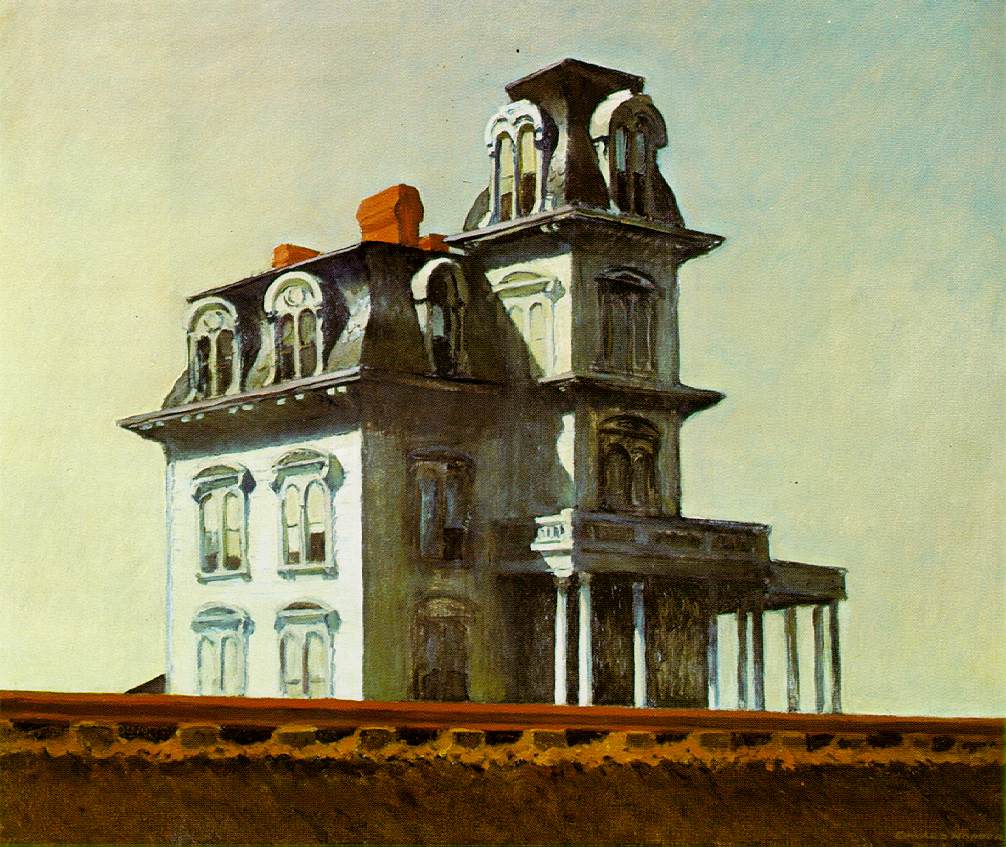
Commonalities in Wyeth and Malick are seen via other influences on Days of Heaven.  Beyond Christina's World, the famous house in the film is almost an exact copy of Edward Hopper's The House by the Railroad (1925) (Images C and D).  And also reflects Hopper's American Landscape (1920) (Image E).

The word "landscape" provides an important clue for our discussion. Much of Wyeth's work features people in a landscape. His landscapes often appear empty, even bleak. Malick's first four films (the fifth is currently in post-production) all feature individuals in conflict in and with their landscape. 

In the significantly titled Badlands (1973) two young lovers go on a killing spree, pursued by law officers. Eventually they build for themselves an artificial environment of tree houses and underground hides. Days of Heaven (1978) features, as we have seen, human v human and human v nature conflicts on the wide open plains of Texas. In the Thin Red Line (1998), US soldiers in World War 2 must scale a steep mountain against the withering fire of entrenched Japanese soldiers, protected only by deep but fatally thin grass. In the New World (2005) English colonists in 1607 battle with the alien environment and alien peoples of what is now Virginia. native princess Pocahontas marries one of them and must in turn face the equally alien urban landscape of Jacobean England - the New World of the title.  The content of Tree of Life, currently being edited and scheduled for release in November 2010, has been kept vigorously secret.  But we know it is set in the Midwest of the 1950s, and rumours claim it is "an inter-generational rights of passage drama in the style of John Steinbeck". 

Morrison and Schur sum up parallels in Wyeth and Malick thus, "these works share a concern over the effects of modernity on the relationship bet humans and their environment . . . the ways in which industrial culture . . . may be seen to displace humans from their sense of connection with nature". (The films of Terrence Malick, by James Morrison, Thomas Schur)

These mutual 20th Century concerns have a long history which goes to the heart of American culture.  And indeed to that overlap between "popular" and "High" culture.

Well into the 19th Century both American intellectuals and nationalists bemoaned the lack of a genuinely domestic culture. It was argued that across all art forms the US was still effectively an offshoot of Europe in general and England in particular. 

A genuinely vernacular American culture is often said to have begun in literature, it's hallmarks important to this discussion. Fenimore Cooper's Leatherstocking novels (Last of the Mohicans et al), begun in 1823, and Melville's Moby Dick of 1851 are regarded as important landmarks. These have in common men (sic) battling against nature or each other outdoors in land- and seascapes. They also share a sort of simplicity. 

That word is used here not to mean intellectually vacant or simplistic. But that this trend reflects the cultural tradition of the US North East for religious, spiritual and cultural simplicity, as the word is used by Quakers.  An overt and self-conscious attempt to get away from the Old World of Europe with its fustiness, tradition, and class hierarchies. It's rococo and baroque. The woodland battles of Leatherstocking can be seen in this light as the antithesis of the drawing rooms and psychological interiority of the likes of Jane Austen.

Around the same time another literary and philosophical tradition emerges, Transcendentalism, characterised in literature by Henry David Thoreau's Walden (1854) and the poetry and essays of Ralph Waldo Emerson. Both reflected similar themes of simplicity and nature.  Andrew Wyeth's father N.C. Wyeth was very influenced by the Transcendentalists.

In the 1840s, American expansion westwards took off with the later to be traditional Hollywood wagon trains of settlers heading across the Plains. Simple people battling with and in new landscapes. With them went artists who visually idealised both the landscape and the noble settlers, often backlit, Malick-style, by the setting sun. Famous examples are Leutze's 1851 Westward the Course of Empire Takes it's Way (Image F) and Bierstadt's 1867 Emigrants Crossing the Plains (Image G).  Judged by the values of High Art these classics of 19th century Western art now appear cliched, populist, even embarrassingly politically incorrect.

In their footsteps followed the more artistically worthy Frederic Remington (1861 to 1909) (Image H) and Charles M Russell (1864 to 1926) (Image J). The work of both can be seen to be less sentimental, less "corny" than Leutze's and Bierstadt's. Yet both feature heavily the themes of cowboys, horses, Indians, soldiers - men (sic) battling in and with landscapes.  Their paintings could easily serve as storyboarding for Western movies.  And both men's lives overlapped with the beginning of that genre, 1903's silent The Great Train Robbery.

The Western artists were followed, though not literally, by the popular literary fraternity. Western adventures became a common theme in the explosion of ‘dime novels’, the U.S.  equivalent of the British ‘penny dreadful’. Churned out factory-style by hacks who had never been West of the Appalachians these represented the undeniably ‘low’ end of American literarture.

But a whole new standard of literature was reached with the publication of Owen Wister’s The Virginian in 1902. Not only does The Virginian work as serious drama, it explores intelligently the very real social conflicts of the 19th century West. The background to the Virginian lay in the 1892 Johnson County War, a violent confrontation between rich, "big" cattle barons and poor, "small" farmers, mostly recent migrants from Europe and Russia. Which in turn directly spawned the 1980 Heaven's Gate and the 2002 Johnson County War. But the ranchers vs. farmers battle became one of the most common tropes in Western films, feeding into the likes of Shane (1953) and The Big Country (1958).

We are now into the 20th Century and can connect our chain of links to the Wyeth family.  Andrew's father, N.C. Wyeth was commissioned in 1904 by the Saturday Evening Post to illustrate a Western story. His teacher and mentor, Howard Pyle " . . . urged Wyeth to go West to acquire direct knowledge, much as Zane Grey had done for his Western novels. In Colorado, he worked as a cowboy alongside the professional "punchers," moving cattle and doing ranch chores. He visited the Navajo in Arizona and gained an understanding of Native American culture. When his money was stolen, he worked as a mail carrier on horseback to gain back needed funds". This was the first of several trips West by Wyeth senior.

Thus we have traced a tradition of vernacular American culture in which painting, literature, landscape and Westward expansion go hand in hand.  A tradition in which 'High Art' and popular culture, including illustration, sit together on an undivided continuum. Characterised by simplicity and populism, and by themes which both reflect and entertained "the people". Heavily featuring the outdoors in general and the trans-Missisippi West in particular.  All of which provided fertile material for Hollywood movies in general and The Western in particular.

This was the cultural stream into which both Andrew Wyeth (1917) and Terrence Malick (1943) were born, and by which both were heavily influenced. Wyeth was there first, but both drank from the same waters.

And the tradition has continued during their lifetimes.  The literary inheritors of the Melville / Fenimore Cooper tradition include Ernest Hemingway (1899 to 1961) and Norman Mailer (1923 to 2001). In painting we may note Harvey Dunn of South Dakota (1884 to 1952), notably his 1950 The Prairie is My Garden (Image K).  And California's Maynard Dixon (1875 to 1946), with works like 1942's Open Range (Image L).

After Wister's The Virginian, Western literature continued to evolve in the 20th Century.  The novels of the hugely popular Zane Grey are credited with having spawned no less than 110 films.  But also inspired a 'wealth' of lesser writers, lampooned via Joseph Cotton's Holly Martins character in the British film noir The Third Man (1949). 

The contemporary writer, Cormac McCarthy on the other hand has achieved genuine literary recognition via various awards including the Pulitzer Prize for works in several genres as well as the Western.  And for providing starting points for movies such as No Country for Old Men (2007).  Another contemporary writer is the prolific Larry McMurtry, whose writing ranges from the more or less conventional cattle drive plot of Lonesome Dove (1989 and 1993) to the screenplay for the artistically acclaimed gay cowboy movie, Brokeback Mountain (2005).

Every artist or author named so far, and all who will be named further on, is a man. Their themes are relentlessly masculine. Their works have often been denounced as patriarchal, sexist. Their content privileges male physical struggle, and tends to reduce women to, at best, secondary and support roles, and at worst, complete absence. More of this later.

It is often said that the art form of the 20th Century has been film.  And that film has been THE American art form,  the USA's unique and technology-based contribution to the evolution of the creative arts. Since the arrival of sound, cinema has brought togather the literary / theatrical and the visual.  And the simple, outdoors tradition of the Western has been at the heart of that fusion. 

Two of the greatest names in American cinema, and among the strongest visually, are John Ford (1894 to 1973) and Howard Hawks (1896 to 1977).  Both Ford and Hawks were worshipped by the directors of the French New Wave as auteurs and as powerful influences on their own work. Influence often ignored by those who assert that rigid separation between the 'art film' of the elite and and the 'popcorn movie' of the vulgar masses.

Hawks' 1948 Red River and Ford's 1956 The Searchers are celebrated as two of the best American films ever made (Images M and N). Both feature the man who can arguably be designated the absolute antithesis of the arthouse film - Iowa-born son of the Midwest Marion Morrison, stage name: John Wayne. It seems incongruous to use his name in the same sentence as the word 'art' so much does Wayne appear the embodiment of all that is regarded as commercial and vulgar in US popular culture.

Yet Wayne's minimalist acting style, and his mumbling, plain-speaking characters, usually set by Hawks or Ford backlit against a wide-open sky in a vast landscape, represent the themes that link Andrew Wyeth and Terrence Malick - the simple, the strongly visual, the outdoors, people in landscapes much bigger than they are. Ford's famous habit of tearing out many pages of dialogue preferring to "show it rather than say it" worked perfectly for Wayne.  And vice versa. Malick often uses his male actors similarly. In Days of Heaven a female voiceover narrates while we watch the less articulate men in action. Wayne continues our theme of the aggressively, conventionally masculine. 

Malick's films are overwhelmingly populated by male characters, who will generally be fighting each other.  Casting delivers to us established Hollywood stars who combine hearthrob good looks with traditional masculinity: Martin Sheen (Badlands), Richard Gere and Sam Shepard (Days of Heaven), Sean Penn and George Clooney (The Thin Red Line), Colin Farrell and Christian Bale (The New World), Brad Pitt (The Tree of Life).  Female characters are there to be loved, fought over, dragged along, or to narrate.  The best known actress in a Malick movie was Badlands' Cissy Spacek from way back in 1973. Since then no Malick film has featured a very well-known actress.

We can finish by pulling together the cultural streams from which both Andrew Wyeth and Terrence Malick appear to have emerged.  All can be seen to be part of the evolution of a vernacular American culture characterised by simplicity, the visual, and the landscape. What can be shown literally is privileged over the abstract, ideas, intellectualisation. Malick, despite his artistic auteur persona, fits within the mainstream US traditions of literature, Western art, and film.  He also prioritises visualised action over words, and features Western landscapes, masculine themes and images, and conflict between men.

All of which challenges those who come to Wyeth's and Malick's works from the perspective of traditional 'High Culture'. From Manhattan and Boston to London and Paris intellectual elites have their preferences. and prejudices. Film should privilege ideas and words over action. Novels should feature strong characters and complex plots, not physical action.  'Art', cannot by definition be too popular.  Andrew Wyeth's huge attendance figures automatically make him suspect in a world in which being part of an elite minority is a qualifying requirement for artistic status; art can only be Art if its' creators, creations and consumers are in some way 'special'.

Above all, 'the artist' should be a million miles away from the cigar-smoking, bullfighting machismo of John Wayne or Ernest Hemingway.  Which brings us to another and final psycho-cultural split, the socially constructed separation between male and female, men and women. 

In its traditional social role 'art' has stood between and linked the two worlds.  Male artists and writers are expected to be sensitive, able to explore the inner world, to understand their female characters. Male homosexuality is far more accepted in the world of high art than in the military or Western settings of Ford, Hemingway or Mailer wherein men are without exception always 'real'.

Andrew Wyeth and Terrence Malick can both also be understood to link the cultural worlds of the masculine and the feminine. In Wyeth's work we see the traditional American outdoors, yet an absence of aggressive, violent masculinity. When his subjects are women, he appears to understand them empathically. 

Malick's films overwhelmingly involve men in violent conflict, and yet the the films' overall visual and narrative style is a long way from the standard Hollywood action film. The word "lyrical" is overwhelmingly used to describe his films, which seems to refer to that transcendental, out-of-body quality which results from the combination of music and voiceover with hypnotic cinematography. While we see men behaving badly in his films, they are enveloped by an artistic process that is somehow female, conveyed to us via sound and image.  The sound often involving that female narration. Men do. Women notice, feel, examine, talk.

Furthermore his male characters can be divided into two types.  On the one hand are those who we see very clearly to be experiencing terror. The young soldiers in The Thin Red Line, Colin Farrell's John Smith in The New World. These characters are complemented by men driven by the calm, gentle version of love, known by the Greeks as 'agape', rather than the murderous, lustful form. Sam Shepard's gentle farmer in Days of Heaven, or Christian Bale's gentle farmer who rescues Pocahontas via marriage in The New World.

On the other hand are the most violent of Malick's men. Those who are driven to violence by passionate emotion or desire: Richard Gere in Days of Heaven. Or by an almost emotionless, even psychopathically calm aggression: Martin Sheen's killer in Badlands, or Nick Nolte's screaming officer in The Thin Red Line, cajoling and threatening his scared young soldiers towards their deaths.  

To conclude, when we compare the paintings of Andrew Wyeth and the films of Terrence Malick we are challenged to reconsider elitist assumptions as to a rigid separation between ‘high’ and ‘popular’ art, and in parallel, the between ‘art films’ and the commercial cinema.


This is an excerpt from an interview included with John Bailey, the camera operator on the film. The DP was Nestor Almendros and then Haskell Wexler took over to complete production. One of the most stunning looking films in the history of cinema. Large portions of the film were shot outdoors with little or no artificial light in what is called the "magic hour", the period in which sunlight gives way to night. Almendros used 50mm lens with the aperture opened to the maximum (f-1.4 and f-1). 


Saturday, June 26, 2010

David recommends . . . go and see GOOD HAIR

It's funny, and you'll learn about that of which 95% of UK citizens are ignorant - black women's hair.  African-American comedian Chris Rock takes us on a personal journey of discovery through the multi-billion dollar world of black people's grooming products, extensions, weaves, and wigs.  Along the way you will be informed, worried, and made to laugh. A lot.

Do you know what hair relaxer is? Creamy crack? What are the groundrules when making love to a woman with a hair weave? No? You must be white. And need enlightenment. Whatever your skin colour, you need to see what happens to a Coke can when immersed in the same chemical as straightens hair.

Rock's odyssey begins and ends with an apparently simple question from his adorably beautiful - and of course black - baby girl. "Daddy, why can't I have good hair?" Good meaning straight and fine, like the white folks. Rock explores the highly toxic chemicals used on children as young as 3. The hair that is given away in India for nothing, then fixed onto black women's heads in the US for anywhere from $1000 to $3500. The huge and highly profitable industry which is mostly owned by white people.

A celebrity line-up of actresses, models, hairdressers, plus no less than Maya Angelou (first straightened her hair at the age of 70) and the Rev Al Sharpton (first straightened his hair to have more political impact) provides an entertaining and always insightful flow of hilarious testimony.  Structured around the narrative thread of an astonishing high-end hair styling championship. Who will win? The black woman who cuts upside down? The one who cuts underwater? The gay black man?  Or the gay white man? Hold your breath.

GOOD HAIR is a rare feature theatrical release as it works equally well on two levels, as great and unrelenting comedy, and as a serious documentary asking serious questions about fashion, ethnic identity, and commercial exploitation.

It's one disappointing weakness is it's cop-out ending. What will Chris Rock say to his baby girl about her hair?

Monday, June 14, 2010

David recommends . . . go and see VINCERE. And reviews THE KILLER INSIDE ME, THE HAPPIEST GIRL IN THE WORLD, and FOUR LIONS

VINCERE is a must see, best film currently on release. Italian language historical drama about the spurned first wife of a young Benito Mussolini.

In the heady days before World War 1 Ida and Benito are revolutionaries and lovers. They marry, she has a baby boy - Benitito. During the war they lose contact. The War splits the European working class movement, into Communists, Social Democrats, and Nationalists. The latter develop into Fascists. The rest is history.

Ida bumps into Benito, fast rising in Italian politics, and is horrified to find he has a new wife and more children. Mussolini is equally horrified. Ida and Benitito are a political embarrassment and a threat to his rise and that of his party. They must be got out of the way. Enter Blackshirts, corrupt officials, oppressive psychiatrists and enveloping nuns.

As mother and son are separated what follows is a heart-rending tragedy, but stands as an homage to the endurance of the human spirit. Ida's and her son's respective struggles against an engulfing power which demands they deny reality can be read as a metaphor for Italy, and Europe, under totalitarianism.

Go and see it. Took me a while to get over the fact that the young Mussolni appears to be played by a cross between Groucho Marx and Michael Corleone at his angriest. But it's wonderful.


THE KILLER INSIDE ME, or "The Violent Film" as my friend called it who was not planning to see it. That reflects an unfortunate trend in the reviewing which has emphasised the violence in the film and especially that against women.

But much of this attention has seriously misrepresented the film. It is not in any way misogynistic. 50% of the victims of the central character are male. Equal Opportunities psychopathy if you will.  Most of the screentime does not involve violence. And in act is slow and lyrical, with high visual production values. Imagine LA Confidential set amid the Texan desert and filmed by Terrence Malick.

It is precisely this languid feeling which sets up the shocking nature of the violence. Those episodes are, as anyone in Cumbria will tell you, a sudden and brutal interruption into the normality of rural life. IN the lead role Casey Affleck portrays just that. His Deputy Sheriff, mocked for not even carrying a gun, appears hyper normal, in a rather boring, nerdy way. The typical "quite loner" in a "tight-knit community". A quasi-Freudian backstory establishes, as with so many violent men, motivations around the very oppoaite of domineering machismo.

Hence the reviews do not reflect characterised throughout with ceaseless, brutal violence. This is not an action movie. Suddenly and without warning we find ourselves watching what is, indeed, one of the most distressing look-away sequences I have ever seen. This sequence is overwhelmingly responsible for the accusations of gratuitous and misogynistic violence. For unusually, the camera remains relentlessly on the victim's face, in close up, as they are bludgeoned. No cutaways to the killer, or to blood spattering on a wall.

An alternative reading to this sequence can suggest two things. First that we are being forced into the position of the killer. Seeing the victim's face gives us his point of view. That makes us extremely uncomfortable, as we all wish to deny our own potential for aggression and violence. Secondly, and via the suddenness of the violence, we are forced to face up to the reality of domestic violence. Thus we are in that long-running debate about the nature of violence in film. The argument that if we are to have violence in films it ought to be realistic. Otherwise film-makers are accused of dishonesty, even of minimising it.

Hence a dilemma for filmmakers. Omit domestic violence as a subject and they will be accused of ignoring a huge and serious social problem and the most acute manifestation of men's oppression of women. Include it in the script but do not show it on screen, or show it in sanitised form, and they will be
accused of inadequately representing its' full evil.

Darling of British art cinema Michael Winterbottom has taken the third option and pushed the envelope. Extreme domestic violence is hard to face up to. The victim's disintegrating face is equally hard to look at. I initially looked away then forced myself to watch, to honour the honesty and daring of the filmmakers.  It was not fun.  But then murder is not fun, whereas in thousands of popular movies it is treated as fun or at the least as not a big deal.  If you are going to see a film about a killer this year, this is it.

THE HAPPIEST GIRL IN THE WORLD

Second best film out at the moment. A gentle, wry, observation comedy from Romania.

Mum, Dad and teenage daughter Delia are hicks from the sticks on the way to Bucharest.  Delia is miserable, hence the irony of the title. Arriving in the big city she exclaims "There are just so many of them - people!"

This clash between rural Romania, expressive of the old days of Communism, and the brash, modern, increasingly Western city culture of the capital lies at the heart of the film.

For Delia is here to film a TV commercial for orange juice, having won a car in a competition organised by the manufacturers. To get the car she has to do the ad. Which puts her and her embarrasing rube parents into the alien world of capitalists, advertising agencies, film crews, and all-round commercialism. Will they sink or swim?  Mayhem ensues.

Conflict are everywhere. Mum and Dad appear to hate each other. Delia seems to hate them both. She wants to keep the car, while Dad is fixing up a buyer even while she is filming the ad. Another metaphor for changing Romania. Dad needs the money to solve the family's financial problems and invest in a new capitalist enterprise, a guest house.

Andreea Bosneag is superb as the unremittingly unhappy adolescent, tubby, spotty, awkward, unreasonable, tearful. Parents of teenage children will both love and hate her. Yet by the end of the film we admire her strength and determination. Perhaps a third and final social metaphor, as she stands up to the harassment of Mum, Dad, the make-uo lady, the bitchy ad agency woman, the director, the client . . .

FOUR LIONS

A tragedy. Chris Morris is a comedy genius. How did he make this rubbish? How did this script get the money to be made?  It is just not funny. In an audience of 20, one man laughed at intervals throughout and one woman laughed several times in the final few minutes. The other 18 of us? Not a titter.

The set up must have looked promising. Morris as the creative behind it. Timely and yet controversial subject matter as four home-grown British Moslems plan a suicide attack on the London Marathon.

But it is just not funny. And there is not enough going on until the final minutes to work as drama. The characters and and their motivations are unbelievable.  A rare strength is Riz Ahmed's strong performance as leader Omar, constantly frustrated by the incompetence of his fellow jihadis.  But not strong enough to raise this dire production.

Miss it at all costs.

Thursday, June 3, 2010

David recommends . . . . . . that you go and see THE BAD LIEUTENANT: NEW ORLEANS - PORT OF CALL


This is the best movie currently on UK release. It's Ray Milland in The Lost Weekend meets The Wire, then speeded up, and with gags. This is what a Quentin Tarantino movie could be like if he wasn't so pompous, derivative, and over-indulged. In post-Katrina New Orleans, Nic Cage is a cop hero who goes off the rails via prescription drugs and then too much coke. 


Forget Abel Ferrara's Bad Lieutenant. That was all Catholic wallowing in guilt and remorse. This is the Protestant version, fast action, witty one-liners, and redemption.  For as our detective hero spirals down into the traditional drug-fuelled personal hell he never loses sight of his core and morally pure objectives. Put away the Bad Guys. Protect your loved ones. Even if he starts hallucinating iguanas on the way.

Art movie fans wil be tempted to avoid BL:NO-PoC because it stars Nic Cage, sparkles with street talk, and looks like a would-be blockbuster. Popcorn fans may do the same because it's directed by, gosh, Werner Herzog, usually in the Euro-subtitle category at the video store.


But the whole point of this film is that it proves the fallacy of the rigid split between art house and commercial. Like all socially constructed tribal differences, those two gangs have been popping off at each other like, well, the drug gangs in this film. 

But as Nic goes loopy we see a fine film which operates in an overlapping filmic space. Who better to direct than Herzog? Famed for portrayals of weird and / or obsessed men: Aguirre -  Wrath of God, Fitzcarraldo, The Engima of Kaspar Hauser, Nosferatu the Vampyre. BL:NO-PoC is a thoroughly intelligent piece which invites us to reflect on morality, duty, family and the parallels of social and personal breakdown.

Who better to play the eponymous hero than Cage? For whom this film also represents the healing of a his own schizoid career. Since appearing as Nicolas Coppola in wacky High School movie Fast Times at Ridgemont High, he has alternated between zany comedies and rom-coms (Raising Arizona, It Could Happen to You, Honeymoon in Vegas), and would-be Arnie / Bruce / Stallone hard-man action flicks (The Rock,  Lord of War, Con Air). With attempts at serious drama in between (Leaving Las Vegas, City of Angels).

So the at first sight unlikely pairing of ultimate Hollywood brat Nic and former New German Cinema wunderkind Werner really works. BL:NO-PoC is fast and sassy and an engaging drama, while at the same time being genuinely funny, on the dark side.


Cage is surrounded by a rich and multi-ethnic cast of character actors whose cops and gangsters could be interchanged, and supported by gorgeous pouting Eva Mendes in the strongest performance of her career, also set free from popcorn action like 2 Fast 2 Furious.

Yes, Hollywood can make a seriously good movie.  And above all, BL:NO-PoC shows that the Academy must set up a new Oscar, the award for the Best Performance By A Reptile.


Thursday, May 27, 2010

David begs . . . PLEASE do NOT go and see SEX AND THE CITY 2

OK, I admit, I've not actually seen it. On the other hand, I have always been a huge fan of the series. Just like the Guardian's Hadley Freeman, who has seen this Crime Against Cinema.  She says,

"I'm not asking too much. I just don't want to be sick in my mouth. I don't want to leave the cinema feeling like I've paid £7.50 to be mocked, patronised and kicked in the face. . . . the pink-fringed, cliche-ridden, materialistic, misogynistic, borderline racist SATC2".

The dual thrust of Freeman's blitz is that the TV series was wonderful but that the two films are a travesty in their distortion of the original and feminist themes of that series. 

" . . . the show was fantastic: smart, funny, warm and wise . . . It was about four smart women, three of whom had no interest in getting married . . . it had genuine emotional truth".

Whereas in the films we see "self-obsessed babies with breasts", and in SJP's Carrie, " . . . a demented harpy, one whose response to having been jilted at the altar was 'How am I going to get my clothes?' "

This betrayal of women in general and the series in particular is best seen, says Freeman, via what happens to lawyer Samantha's career. Miranda's partner Steve was unfaithful in the first film because her job meant she did not give him enough time and attention.  Thus the trauma of sudden singlehood was clearly her fault. So in the second film she leaves her job, responding positively to Steve's suggestion she could "be at home and help around the house". Freeman: "Sorry I think I just burned my fingers while retrieving my bra from the fire".

Then there's the racism. SATC the TV show was always vulnerable to that charge.  Without major black or ethnic minority characters, "the only ethnic minorities you see . . . are waiting behind counters to sell the women expensive handbags".  SATC2 cranks this up a notch, as the gals decide, bizarrely, to take a holiday in Abu Dhabi.

"Not since 1942's Arabian Nights has orientalism been portrayed so unironically. All Middle Eastern men are shot in a sparkly light with jingly jangly music just in case you didn't get that these dusky people are exotic and different".

Thus Freeman concludes "The death of Sex and the City is not just a shame for fans, but for all women".

Just from seeing "the hideous trailer" (and so before reading Freeman's review) I was instantly struck by that "beyond its' use by date" feeling you get when smelling a particular object just taken from the fridge. Readers, in the next sentence you will think I am being appallingly sexist, but please persist. Because the fabulous foursome just look TOO OLD.  Samantha looks like she has been dead for a week. Charlotte's Kristin Davis, one of the most beautiful and elegant women on the planet, looks like an over-made-up tart. But I do NOT mean as women they ARE too old.  I'm 54 so all 4 of these women represent spendidly attractive younger women to me.

In the film they LOOK to old for the function the characters play in the too-long extended narrative theme of the overall SATC project. The actresses are NOT too old for the characters, who are meant to be women in their 40s and 50s. It is the characters that are too old for the socio-economic narrative which lies beneath the personal human stories. 

Freeman seems in touch with this: "A woman can love fashion without looking and behaving like an international call girl".  In fact Hadley, in recent years Lady Gaga, Britney Spears and Christina Aguilera have done exactly that in music videos to great artistic and commercial effect. All of them building on the principle established by Madonna back in the 80s that women's autonomy includes the right to dress like a whore.

The difference is not just that Lady Gaga is 30 years younger than Samantha's Kim Cattrall. The characters in SATC are past their sell-by dates in two other ways.

Freeman rightly, being a feminist, deplores that the women now "want a ring at all self-abasing costs".  That "self-abasing" is the clue.  Like ageing prostitutes they have all left it a little bit late for the ring-snaring, Hence more and too many layers of make-up are needed. That's not your reviewer being sexist. That's the reality of the situation the characters find themselves in, living in a patriarchal, sexist society and having spent 10 years since the series began in 1998 enjoying a crypto-feminist life of independent careers, independent sex and, um, independent shopping. 

Having suddenly decided to jump back into Doris Day-land they are playing an embarrassing catch-up. Hence Samantha's 44 pills per day "to trick my body into thinking it's younger".  And Miranda's retort that she has "tricked my body into thinking it's thinner - Spanx!" I assume this is not what suffragettes starved themselves and threw themselves under horses for.

As an outsider on the female race, I found SATC 1 and the trailer for SATC 2 embarrassing precisely because of this 'self-abasing".  Especially when unsuccessfully spun as feminism - we are asked to be on board with it being these strong, independent women's right to choose to dress like this and look to snare a man.

But there is a level here deeper than Freeman's rather routine feminist analysis and critique.  For her this all amounts to a male patriarchal conspiracy, in the world at large but also in the Hollywood system that has subverted the genuine feminism of the TV series. All of which is true.  

But patriarchy brings about a downside for men, which more and more of us began to understand in the late 20th Century. It is correct that men in general have more wealth and more power globally than women in general.  But patriarchy, strictly speaking, is the rule of SOME men over the rest of us.  All women are subordinate, but so too are many men. Hence the 'pater' (Father) in patriarchy and the Mr Big in SATC.

Freeman is correct to lament that "There is a deep sadness in the sight of Carrie and her friends defining themselves by . . . their ability to snare and keep a man".  But we can reach deeper than her feminist analysis via Marcuse, who lamented that human beings define themselves by their consumption of pointless commodities. Jimmy Choos, anyone?  Throughout the high-flying period of the TV series, no one, least of all within the programmes, did anything other than enjoy and envy the 4 women's glorious lifestyles. In which buying clothes and accessories were actually more important than careers and sex.

For Marcuse, the enjoyment of this consumer lifestyle is not only illusory but damaging. It makes us "unfree". We are enslaved in the minds just as once humans could be enslaved in their bodies.  In this state of unfreedom "consumers act irrationally by working more than they are required to fulfill actual basic needs, ignoring the psychologically destructive effects, ignoring the waste and environmental damage it causes, and also by searching for social connection through material items" (Wikipedia).

Throughout the TV series, Miranda, Carrie, Samantha and Charlotte were never, um, actually seen working very much, though all had jobs or careers. Something else in SATC2 is past its' sell-by date, not just the make-up and fashions of the foursome. In a patriarchal system it is men who are expected to pay for all those consumer items as the 'father-provider'. Both women and men work to create the commodities. But a small minority of men have far more purchasing power than the rest. Few men watching the TV series could afford to buy their wife or girlfriend a pair of Jimmy Choos. 

This is what Mr Big represents - the patriarch, the father, the rich man.  When the women get round to self-abasement time they are not bothered if he oppresses them. They just want him to pay for the shoes. They are now, as Marcuse would say, so addicted to their high-end consumer lifestyles that they will do anything to catch-up and snare their meal ticket man.

SATC was at its' height throughout a lengthy but ultimately fake boom in consumer capitalism. Which began to fall around our ears in 2007. Both the boom and the bust resulted from an over-reliance on financial services and banking.  Real economies, like the current Chinese one, manufacture things. The late 20th Century free-market economies of the USA and UK relied increasingly on people making fake, digital money out of fake, digital money.  And then spreading enough easy but unreliable credit around for buying and selling in an over-inflated property market. And buying Jimmy Choos at the top end.

That system has not now ground to a halt. But a lot less of us will be able to afford Jimmy Choos. Hence back to SATC2. Any young gold-digger knows very well that you need to snare your millionaire early in life. That way, when he dumps you aged 40 or even 30 for a younger model you can already have squirreled away enough to live on. Not to mention that divorce settlement. The unreality of SATC is that these characters are desperate to snare their men at the sort of age when any self-respecting Mr Big would be dumping them. 

The fantasy that got millions of women to pay to see Bridget Jones was that you can be fat and snare Colin Firth (yum). The fantasy of SATC2 is that you can be in your late 40s or early 50s and snare Mr Big and his millions (yum, yum).  During the worst global recession in 70 years.

Hence the self-abasement. I repeat, the 4 lead actresses of SATC2 are all beautiful, desirable women.  The characters they play are past their marry-by date in a patriarchal and consumer capitalist society.  The designer clothes and hideously excessive make-up which makes them look like "international call girls" represents a huge denial of that depressing fact.

Millions of women will pay to go and see SATC despite my and Freeman's imploring to the contrary.  They will face a deep psychological choice as to the message they derive from the film.

Level One is the anti-feminist message that Freeman deplores: you MUST snare a man and your appearance will determine your success. Level Two is even more misogynistic: same as before, but if you are over 30 at the very oldest then you've left it too late and will look like a trollop.

Sadly most of us will also not realise that the financial services-based, free market, inequality-stretching, brain-numbing consumer capitalist system on which the SATC franchise is based is also past its' sell-by date. It will limp on, smelling worse and worse like that thing at the bottom of the fridge as long as fashion shoes are so important to us.  "This is the best mirage I've ever seen", says one of the random male sex / money objects in the film.

So true, comrade, so true.

Monday, May 24, 2010

David recommends . . . that you go and see LEBANON

Das Boot, without the Nazis, meets Waltzing With Bashir, with real actors.  Claustrophobia, traumatisation, atrocity and extreme moral dilemmas.

Lots of you, especially women, won't go and see LEBANON because it's a war film. Others won't see it because it is an Israeli film and you fear a whitewash of that country's invasion of Lebanon in 1982. Some of you won't see it because you are Jewish and you fear a condemnation of ditto.

That would be a shame. 

First because this is an excellent and well-made film with high production values and so ticks all the artistic boxes. 

Second because it cleverly manages a balance between honestly exposing some of Israel's less appealing actions in that conflict, with enabling us to enter into the world of ordinary young Israeli men who find themselves in combat and terrified.

The film enables a strong identification with the four-man Israeli tank crew.  LEBANON'S USP is that through the whole film we are inside the tank.  Our only view of the outside world comes via the viewfinder and cross-hairs of the tank's gunner.  Sharing his point of view we see vividly the horror of war and especially the tragic and brutal fate of civilians caught in the way of the invading Israeli war machine. 

Punches are not pulled.  A breach of international law over weapons options is made clear. The worst horror of that conflict, the actions of Israel's Christian Phalangist allies, is referenced when a Syrian solider is captured.

But macro-politics is brought down to the level of individual distress and dilemma. Our gunner sees, in shocking technologically-enabled close up, the faces of civilians fixed in his cross-hairs. He is ordered to fire. Will he pull the trigger?

One review of LEBANON praised it for it's understanding that war is hell for soldiers. But criticised it's failure to address the reasons why the Israeli troops were in that situation in the first place. I disagree entirely with that view. Our gunner is traumatised by being in peril. But even before the tank reaches that stage it is clearly he is equally traumatised by his moral dilemmas and just by witnessing the horrors of civilian casualties.  For whether he pulls the trigger or not, there are dreadful consequences either way.

LEBANON is based on writer-director Samuel Maoz's experiences as a conscript in 1982 Lebanon. Hence his focus is on the claustrophobic and terrifying experiences of his tank crew. The Guardian has called this an 'anti-war' film.

Two criticisms. 

The photography is beautiful. Lots of light reflecting off liquids and glass. Sweaty, dirty faces caught with one side lit and the other dark. Splendid close ups. But after a while I stopped enjoying this and thought maybe it's a bit discordant? Does this, almost Malick like cinematography really fit the subject matter? Make your own mind up.

Also a bit too pretty are the four actors who play the tank crew. Had me imagining those pastiches of Hollywood movies in which everyone could be a model. The Chippendales Go To War.  Maybe this was to enhance the audience's identification with these poor young men in danger. After all, who cares if an ugly fat guy gets killed?

But all in all this is a fine movie, with excellent performances all-round. 

I hope women will go and see it. Many years ago a UK TV documentary revealed for the first time the day to day lives of soldiers in combat. Next day at the water cooler, I remember vividly one female colleague's astonished reaction. "I never imagined they would not be able to wash!". LEBANON takes this to a whole new level. When you are in a tank and under fire, what happens when you need to pee?


Monday, May 17, 2010

David recommends . . . that you go and see ROBIN HOOD


OK, so it's time for regime change.

The long-term, pugnacious, bullying leader is out. In comes the younger, smarmy posh boy. Who immediately finds the coffers are empty. Railing against the previous regime's fiscal imprudence, public spending is immediately reduced (no more foreign wars) and a savage round of tax increases instigated. Which of course fall overwhelmingly on the poor.

That's right, it's England in the 12th Century, The Lionheart is dead and in comes John. Even more presciently, cracks appear over, yes, Europe. We discover that John's evil coalition partner, Godfrey, is in league with Brussels, sorry the French King, who wants to invade and impose a single currency.

Luckily for the struggling English, two Ozzie heros are on the way to save us in the shape of Russell Crowe and Cate Blanchett as Robin and Marion.

For the new Robin Hood is a thoroughly enjoyable, well-filmed romp with a good blend of gags, romance and fighting.  Making it as good as any in it's lineage and better than most. Certainly better than Kevin Costner's crime against cinema that was RH Prince of Thieves.

But before we list the good points, the downside. 99% of you won't care, but this film sets new record levels of historical, cultural and even geographical inaccuracy. You won't care, but the pre-release propaganda has so emphasised the film's claimed greater accuracy than past versions that you are required to sit through the following.

Big combined cock up in the production design and music departments.  Wherever we find ourselves around Nottingham the landscape is studded with celtic stone crosses and standing stones inscribed with celtic designs. Surely part of Britain's heritage and thus present at the time? But every time the English peasants fancy a knees up it's basically Ceilidh night, with traditional Irish music and instruments. Presumably Ridley Scott thinks Nottingham is in the West of Ireland.

Now onto Cate. There is a Law of Hollywood that all modern movies must feature a Strong Independent Woman character.  And traditionally (Maid) Marion has usually been that. But Cate's performance and the script combine to take this to unheard of levels of anachronism. Wasn't sure whether to laugh or cringe in the final battle scene when Marion suddenly appears on a horse in full knight gear.

Medieval female aristos were often, indeed, strong women. Eleanor of Aquitaine for one. But patriarchal social mores restricted such women to behind the scenes influence on sons and husbands. Not kitting up in armour and swinging into sword-flailing action.  Any such inclination would have been ruthlessly repressed.  Maybe we need a law revision limiting SIW's to films with contemporary settings?

But then Cate has other problems over her social role. In scenes where the audience must grasp that she is a posh lady and Russell her smelly ("You stink!") social inferior she makes Joanna Lumley sound like Eliza Doolittle. But when she is hobnobbing among the peasant hordes she suddenly goes all ee-by-gum Emmerdale trooble at mill. What's going on? Were you not listening to her, Ridley? 

And Robin Hood may not play too well in France, for our cross-channel neighbours are The Baddies. Their invasion-minded King is a bizarre Gollum-like creature who clearly does not shave, probably eats raw garlic, and permanently looks as if he just woke up after a late night of continental-style debauchery.  

President Sarkozy may complain that France did not, in fact, invade England at the time. Or he may not bother, being too occupied laughing at the French invasion fleet. For the Gallic army arrive in what appear to be balsa wood versions of World War 2 landing craft. Except that, get this, they are being rowed, ancient Greek trireme-like. Which does not prevent them hitting the beach at a fair old lick.  And the CGI on the wide shot reveals hundreds of them. It is Troy meets Saving Private Ryan. Ridley, Ridley! Did you learn nothing from the disaster that was Kingdom of Heaven?  Time for the remedial class with Terry Gilliam on Less Is More.

Finally the geography. News reaches Robin and the English Army when they are in Nottingham. 5 minutes later they are on a beach to meet the invaders. What? Have they made it all the way down to the South Coast by plane? Or have they nipped to the nearest bit of beach - on the East coast -  and the French have rowed all the way up the North Sea?

OK, I forgot. This is made for a US audience who do not know their own history or geography let alone that of medieval Yoorp. So time to shut up and tell you the good bits.

Russell Crowe is excellent, in a suitably low key, understated performance befitting a character who starts as a humble peasant archer kowtowing to the nobility. Which sets him up for his epiphany in the obligatory Braveheart-type speech about freedom and liberty.  After which the entire army and nobles and even King John silently accept him as their new leader. Instead of stringing him up on the nearest tree as would really have happened to any 12th century advocate of democracy and equality.

The whole thing looks great, much of it having been shot on location. So lots of rolling green hills, long beaches and imposing cliffs. And the music, even with it's incongruous celtic themes, is great. All combining to make for stirring stuff, plenty of derring do. Strong performances from the obligatory gang of Little John, Friar Tuck et al.

But finally a word on demographics. Russell is excellent, and Cate, despite the accent fluctuations, is good. But are they not both a little, um, old at 46 and 41? Don't get me wrong, I am 54 and as opposed to ageism as the next wrinkly. (Glad that B and Q have that job waiting for me.) But romantic leads in an action picture with combined ages of 87? Surely not.  

Raises two questions about Hollywood thinking.

First, where are the new, young, male leads? Is there a next generation of hunky male stars coming through? I cannot think of any. Contemporary youthful male leads tend to the girly, with Zac High School Musical Efron and Robert Twilight Pattinson. Neither could make it as Robin Hood, unless there is a gay version.  So Hollywood has a real problem here.

All the more surprising that this movie is going down very well with the female under 30 crowd. It was a representative of that demographic who recommended I go ("It's really exciting!").  I saw it in a packed Camden Odeon Screen 1. With lots and lots of young women. Not just couples, but small groups of 3 or 4 young women as well. Is this their return to the action movie? Surely not queuing up to see middle-aged Russell with his top off?  Just coincidence and nothing else worth seeing on at the time?

Or are we back to the Strong Independent Woman thing? For the obligatory SIW is not there because of any Hollywood commitment to radical feminism. It is all about female bums on seats and money money money. The previous generation was happy with Bridget Jones and her giant underpants, accidently tumbling into happiness despite being, um, fat.

The current under-30 generation is maybe no longer satisfied with trad chick-flicks. Brought up on Angelina Jolie's Lara Croft and Uma Thurman's whateverhername is from Kill Bill.  And recently primed with 11-year-old assassin Hit Girl in Kick Ass.  For it's not enough for Cate / Marion to kick ass, she has to be lean and mean so no Bridget Jones cellulite on her, ta very much.

Blame it on Thatcher, or maybe the Spice Girls, but it looks as though testosterone is no longer a male preserve in contemporary Hollywood.